
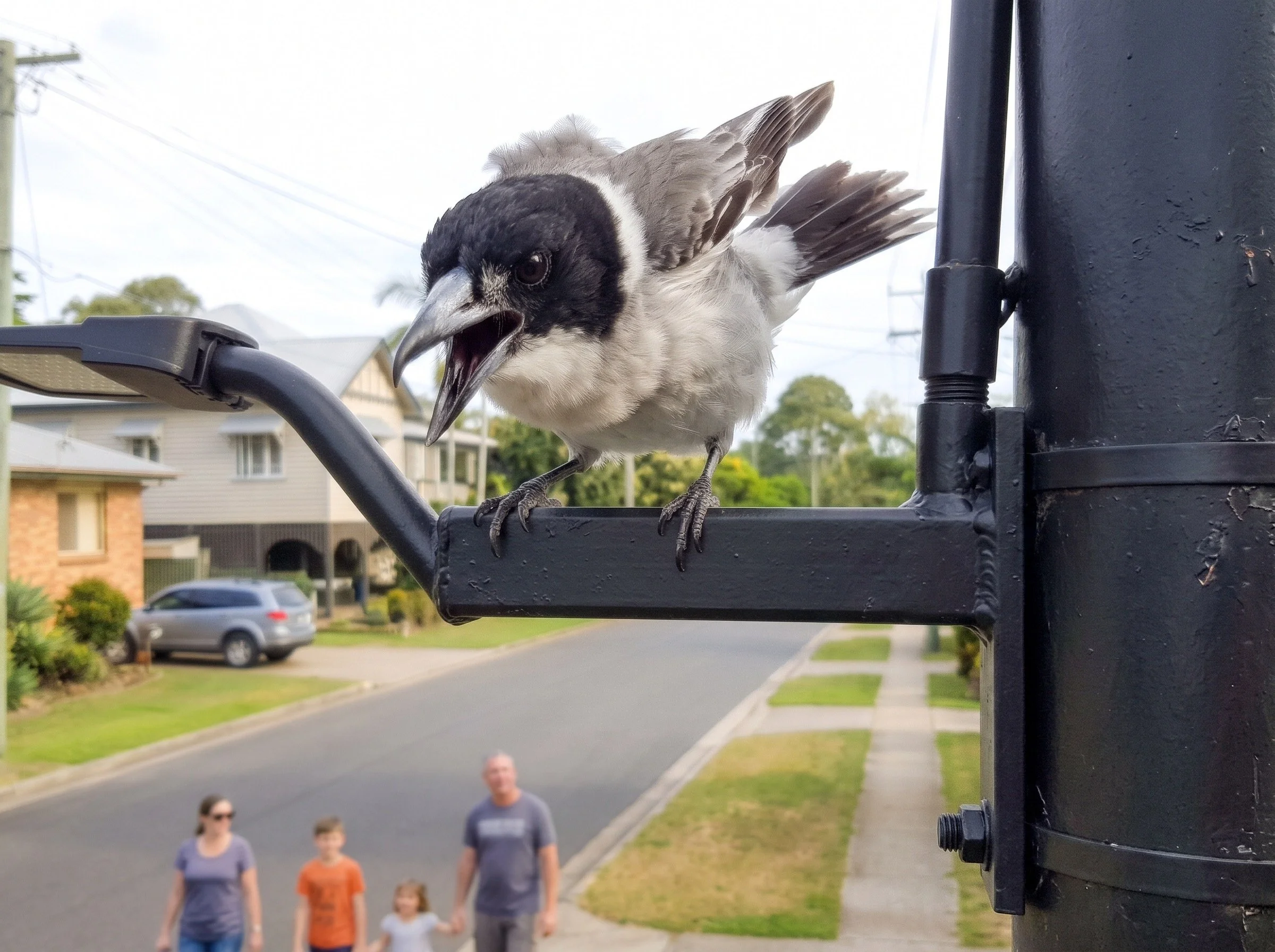
It’s been the talk of the last few weeks: running across the battlefield whilst those butcher birds are nesting (and swooping!) out the front of the practice.
They've been there for two weeks and they have made it very clear that they consider the entrance to Seeking More their personal territory. Anyone arriving for an appointment runs the gauntlet. Staff, clients, delivery drivers, everyone gets the treatment.
A few days ago I was running back home from my car to avoid getting swooped. The ground was wet. I was trying not to slip and not get dive-bombed at the same time, and then I felt a pang in my ankle. Sore and sprained for the rest of the day.
And my immediate, completely automatic response was: ughh those friggen birds!
If it wasn't for them, I wouldn't have been running. If I hadn't been running, I wouldn't have been moving like that. If I hadn't been moving like that, my ankle would be fine. The chain of causation seemed airtight. The birds were guilty.
This is Stage 2 in its purest form.
What Stage 2 actually is
In The 12 Stages of Healing, Stage 2 is called Polarity & Rhythms. It's the Stage of blame, of extremes, of looking outside yourself for the source of the problem or the source of the fix. Life becomes a series of opposites: good and bad, right and wrong, me and them. Something in the environment triggered something in you, and rather than turning toward what was triggered, you aim the charge outward.
It feels completely logical from the inside, because there usually is an external event. The birds were real. The wet ground was real. The sprained ankle was real. Stage 2 doesn't make up the external circumstances. But when we’re in it, we treats them as the full story.
The tell is someone’s language. "If it wasn't for..." "Because of them..." "It's their fault that I...". When you catch yourself constructing that kind of sentence, you're in Stage 2.
Why it's so easy to stay there
Stage 2 is one of the most common places people get stuck, in their health and in their lives, precisely because it's so convincing. The external cause is right there. You can point to it. Other people will usually agree with you. The story holds together.
What it costs is harder to see. When the cause of your problem lives entirely outside you, so does the solution. You're stuck waiting for the birds to leave, or the situation to change, or the person to apologise, or the circumstance to be different. Your own capacity to do anything about it becomes almost irrelevant, because the thing making it happen is over there, not in here. There’s a villain. You’re the victim. But there also must be a hero. Someone you put all your power into.
That's an uncomfortable position to be in once you notice it. Most people don't notice it. They just keep building the case.
The moment it shifted
While I was entraining clients with a sore ankle, genuinely irritated at some birds who had no idea I existed, I caught it.
Not immediately. The initial charge had to run for a bit first. But at some point I started doing what we call AAA in the practice framework: be aware, acknowledge and accept what's actually present rather than pouring energy into the story about it.
What I found underneath the blame was this: my ankle has been a weak point before. This wasn't the first time it's gone. The birds didn't create a vulnerability that wasn't already there. They just created the conditions for it to show up again.
Which means the more useful question isn't "why did the birds do this to me" but "what does this ankle actually need, and why does it keep coming up?"
That's a completely different conversation. And it's one I have some influence over, unlike the nesting habits of local wildlife.
What this looks like in practice
We see Stage 2 constantly, in the practice and, clearly, in the practitioner. Someone comes in convinced their back pain is because of their mattress, or their colleague, or the long drive they did three weeks ago. The external event is usually real. But the back was already holding something before the mattress became the enemy. The charge was already there looking for a place to land.
The job in Stage 2 isn't to talk people out of the story. It's to help them hold both rhythms at once: the part that's in pain and the part that's okay, the part that's angry and the part that's underneath the anger, the external event and the internal pattern it revealed. When those two things can coexist in awareness without one needing to win, the charge starts to settle on its own. For those of you who’ve tried Stage 2 SRI, can you see how the declarations come into play now?
You don't have to decide who's right. You don't have to forgive anyone. You don't have to manufacture a positive spin on something that genuinely hurt. You just stop needing the other side to be the whole explanation.
That's what Stage 2 completing feels like: not resolution, just a slight loosening. The urge to keep arguing the case drops away a bit. Emotional charge settles, and curiosity starts to replace it.
Final thought
The butcher birds seemed to have calmed down. But the more meaningful thing for me, the thing that's actually worth paying attention to, is that my ankle has a history. It showed up before. It'll probably try to show up again if I don't do something about what makes it vulnerable. The birds just made that visible.
That's not the birds' fault. That's actually just useful information, if you're willing to look at it that way.
Where in your life does polarity exist (this vs that, good vs bad, villain vs victim) and where in your body do you feel it? What opposing rhythms are competing within you and expressing outside of you? Give Stage 2 SRI a go and see what comes up.