
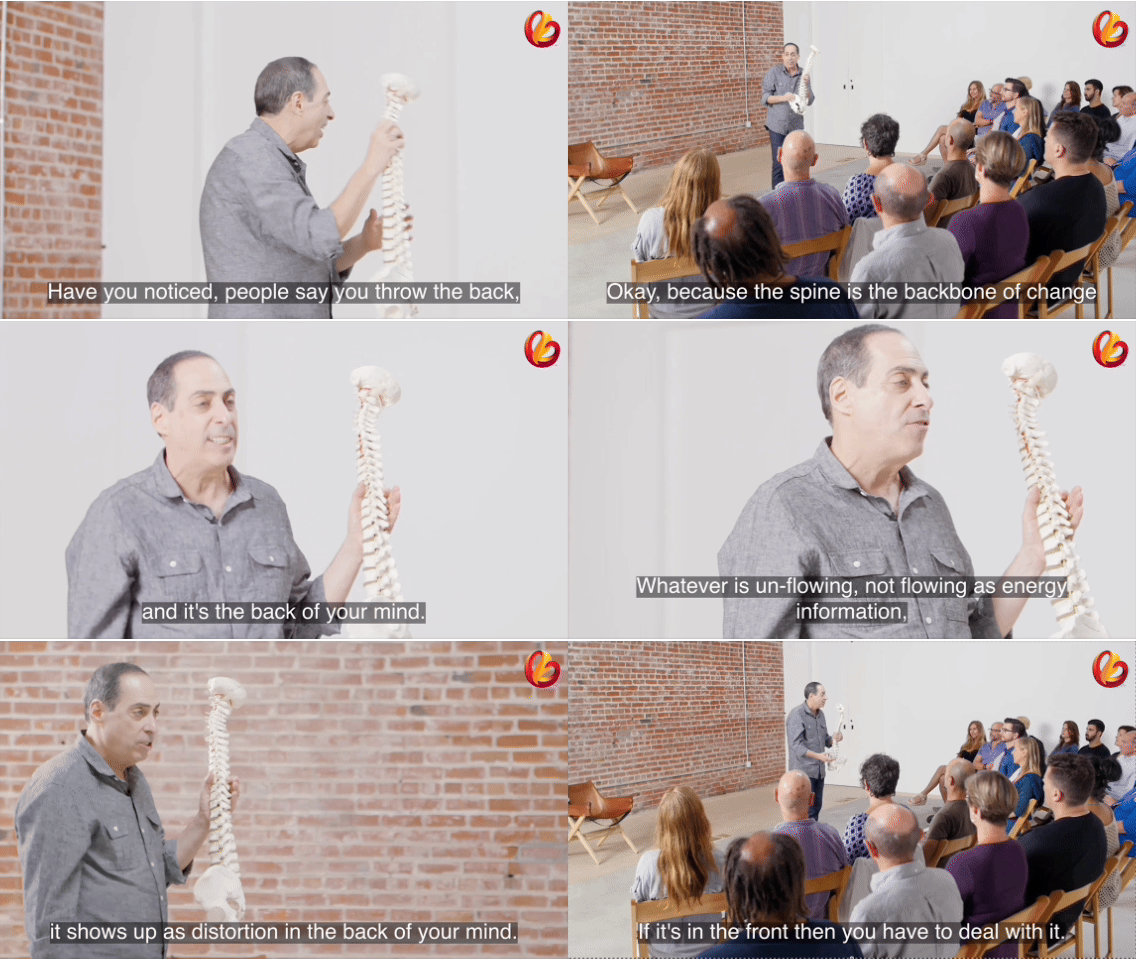
(Pictured) Dr. Donny Epstein
Developer of NetworkSpinal Nervous System Chiropractic Care
Dr. Stefan here, your NetworkSpinal Chiropractor.
This month I wanted to reflect upon the care we practice here at Seeking More, its history, and its ongoing development.
You may not know much about the history of what you’re receiving. You know it feels different from other care you’ve had. You know it's not what you expected. But the story of how NetworkSpinal developed, and what drove it to keep changing, is worth understanding. It gives you a clearer picture of why the approach works the way it does
Where it began
Donald Epstein graduated from New York Chiropractic College in 1977. Like most chiropractors of that era, his early work was grounded in conventional spinal correction: finding what wasn't working mechanically and addressing it.
But somewhere in that early clinical period, he started noticing things the standard model didn't account for. Specific gentle contacts to the spine were producing responses well beyond what a mechanical adjustment would explain. Patients were moving differently. Breathing differently. Sometimes something would visibly shift: a wave moving through the spine and body that nobody had mapped or named yet.
Between 1979 and 1984 he worked with what he was observing, trying to understand it through neuroanatomy, neurophysiology and chiropractic principles. By 1984 he was teaching it to other chiropractors under the name Network Chiropractic.
From Network Chiropractic to NSA
The wave appeared reliably. Gentle contacts at specific spinal areas would initiate a visible undulating movement through the spinal structures, reproducible across thousands of patients and clearly tied to the nervous system rather than spinal mechanics alone. Donny called it the "somatopsychic wave”. By 1985 a “phasing system” of analysis had been added so practitioners could sequence their work based on where a patient was in their process.
In 1994 that system was formalised into three “Levels of Care”, and Donny published his book The Twelve Stages of Healing. Two years later, the work was renamed Network Spinal Analysis and formally described in peer-reviewed literature. The name change reflected a shift: this wasn't just a technique. It was a system of healthcare delivery built around how the spine and nervous system interact, and how the body self-organises under the right conditions.
University-based research began around this time, primarily at the University of Southern California. What researchers found was that the wave had properties of a central pattern generator, a neural network producing rhythmic movement without specific sensory feedback. The most familiar CPG is human gait. The network wave appeared to be a second one in the spine, unrelated to locomotion. Critically, as patients progressed through higher levels of care, the central nervous system became measurably more organised. It wasn't just that people reported feeling better. The underlying neurology was changing. This is what this care can boast about (that many imitations can’t)—it’s done the leg work to prove it.
Into the 2000's and beyond
By the early 2000’s the framework shifted toward wellness education alongside spinal care. In 2007, “Reorganisational Healing” was introduced as a broader paradigm placing NSA within a wider model that included “Somato Respiratory Integration” (SRI) and the Seasons of Wellbeing, a map of how people develop through “Discover”, “Transform”, “Awaken” and “Integrate” phases over time in care.
The advancement from there in the care’s objectives and delivery was enough of a quantum leap that it had to be renamed. The current name, NetworkSpinal, dropped the "Analysis" framing entirely. The spine is now understood explicitly as an information system, a record of how a person has adapted to life. When that system reorganises, the effects extend well beyond the physical.
Why it's an upgrade, not just an update
Earlier versions of the work focused primarily on correcting vertebral subluxation. Find the problem/misalignment/stuck vertebra, address it. That model worked, and the research supported it. But the frame was still correction.
NetworkSpinal operates from a different premise. The goal is to help the nervous system develop new strategies it didn't have before. Strategies that, once established, become the person's own. That's not a correction. It's an upgrade.
The mechanism is the wave. As it develops through care, the spinal and neural systems become more coherent. Coherence means less wasted energy, better coordination, more efficient function. Think of the difference between a flashlight and a laser: same energy source, completely different level of organisation and output. A nervous system running with higher coherence processes information more efficiently, adapts to stress faster and spends less energy holding defensive patterns it no longer needs.
The oscillation that develops alongside the wave reinforces this. “Spinal gateways”, the access points used during entrainments, develop their own subtle rocking motion linked to energy and information efficiency across the whole spinal stability system. The passive structures (bones), active structures (muscels), neural control (nerves and spinal cord) and emotional system start working together rather than against each other. People spend less energy just holding themselves together.
The research still running
The 2016 publication in the Journal of Alternative and Complementary Medicine formally established the network wave as a CPG based on nearly two decades of surface EMG research. It also demonstrated mathematical coherence between the sacral and cervical spine, meaning the wave organises the entire spinal column. The researchers noted the detection methods may represent a new measure of central nervous system health.
A 2018 paper at the IEEE Engineering in Medicine and Biology Conference went further, examining the synchronisation of neuronal discharge patterns along paraspinal muscles using wavelet analysis. The newer hardware confirmed the phenomenon is reproducible and revealed additional layers of organisation within it.
The ongoing program is now tracking whether the CPG undergoes what mathematicians call “bifurcations”, qualitative shifts into new frequency bands that would represent the nervous system moving to a genuinely higher order of organisation, and what the implications are for spinal cord injury recovery and nervous system health more broadly.
These upgrades and refinements over time have taken what was a chiropractic technique in its infancy (Network Chiropractic) to a system of analysis (Network Spinal Analysis), then to the most refined iteration of the work focusing on energy efficiency—achieving more by doing less, for both the nervous system on the table and the practitioner interacting with it (NetworkSpinal). The delivery and quality of the work is different enough that it needed a new name. And people feel the difference. Even those who’ve received NSA for years. Even practitioners of 30 years noticing that they get better, faster and more efficient results learning and delivering NetworkSpinal than they did Network Spinal Analysis.
If you know someone who could benefit from this work, plant a seed for them. Just remember that they have to want it and they have to be ready. NetworkSpinal will challenge us in ways we won’t expect. Don’t fight with timing. Not everyone is ready for this. But never underestimate the power of planting a seed, and something that you say affecting the lives of millions tomorrow in ways you’ll never fully know.